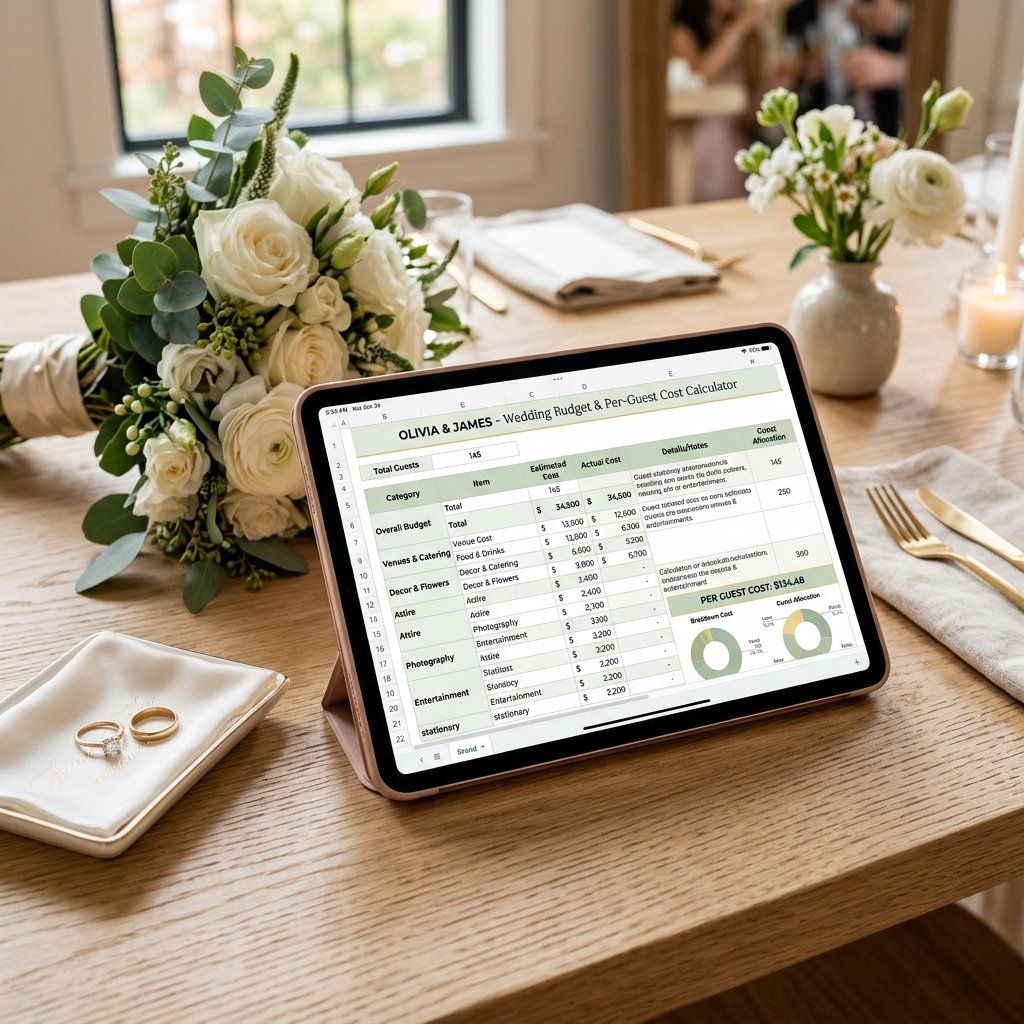
Every name on your wedding guest list carries a measurable financial cost. Most couples intuitively understand this, yet few actually calculate their true per-guest cost before finalizing invitations. The result is a guest list that grows organically based on social obligation and family pressure rather than informed financial decisions. This guide explains exactly how to calculate your per-guest cost accurately, which expense categories scale with headcount, and how knowing this number transforms your guest list decision-making from emotionally driven to financially grounded.
The Difference Between Per-Head Catering and True Per-Guest Cost
When couples think about cost per guest, they almost always think exclusively about the catering per-person rate. If the caterer charges $95 per person, they assume each guest costs $95. This is one of the most consequential misconceptions in wedding planning. Your true per-guest cost is the sum of every expense that scales in proportion to your guest count — and catering is only one component of that total. A complete per-guest cost calculation produces a number that is often 40–70% higher than the catering per-person rate alone, which fundamentally changes how couples evaluate the real cost of expanding or contracting their guest list.
Expenses That Scale Directly with Guest Count
The following wedding expense categories increase in direct proportion to the number of guests you invite. Catering and bar service are the most obvious — these are priced per person and represent the largest per-guest cost component. Invitations, envelopes, and postage scale with the number of households invited. Wedding favors, place cards, and menu cards are per-person purchases. Transportation costs for guest shuttles scale with the number of guests requiring transport. Cake and dessert servings are priced per person in most bakery contracts. Ceremony programs are printed per guest. Venue capacity requirements — and therefore venue rental rates in tiered pricing structures — often increase at certain guest count thresholds.

How to Calculate Your True Per-Guest Cost
To calculate your true per-guest cost, begin by listing every expense in your budget and categorizing each as either fixed (does not change regardless of guest count) or variable (scales with guest count). Fixed costs include photography, entertainment, floral design labor, venue site fees with flat pricing, and hair and makeup for the wedding party. Variable costs include catering, bar service, invitations, favors, cake servings, programs, and guest transportation. Total your variable costs and divide by your guest count. This figure is your true per-guest cost. A couple with $12,000 in variable expenses across 100 guests has a true per-guest cost of $120 — meaning every additional guest invited adds approximately $120 to their total budget.
Using Per-Guest Cost to Make Guest List Decisions
Once you know your true per-guest cost, guest list decisions become quantifiable rather than purely emotional. Adding 15 people at $120 per guest costs $1,800. Reducing by 20 people saves $2,400. If you are over budget by $1,500 and your per-guest cost is $130, removing 12 guests closes the gap. This mathematical relationship does not make the social decisions easier, but it does clarify exactly what you are trading off. Couples who know their per-guest cost before finalizing their guest list consistently experience less end-of-planning financial stress than those who make guest list decisions without a clear financial framework.
Per-Guest Cost Benchmarks for 2026
Per-guest costs vary substantially by region, venue type, and wedding style. Budget-conscious weddings in smaller markets with moderate catering packages tend to produce per-guest costs in the $75 to $120 range. Mid-range weddings in metropolitan markets with full open bar service typically run $150 to $220 per guest. Premium weddings with multi-course catering, premium open bar, and elaborate florals in major cities often exceed $280 to $350 per guest. Knowing where your planned wedding sits on this spectrum helps you validate whether your per-guest cost calculation is realistic or whether it is missing a cost component.
Children and Vendor Meals: Adjustments to Your Per-Guest Calculation
Two guest categories require adjustment in a per-guest cost calculation. Children aged twelve and under are typically charged at 50–60% of the adult catering rate by most caterers, meaning they reduce your average per-guest catering cost slightly. Vendors — photographers, videographers, band members, and other service providers — are typically required to receive a vendor meal under most catering contracts. Vendor meals are usually charged at 40–60% of the guest meal rate and should be counted in your headcount calculation even though these individuals are not invited guests. Forgetting to account for vendor meals is a common oversight that adds $200 to $600 to catering invoices unexpectedly.
Frequently Asked Questions
Does my per-guest cost go down as I add more guests?
Not in a straightforward way. Fixed costs like photography are spread across more guests as your list grows, which technically reduces the fixed-cost-per-guest figure. However, variable costs — the majority of per-guest expenses — stay roughly constant per person. In some cases, adding guests beyond a venue's base capacity triggers a tier increase in venue fees, which can actually raise your per-guest cost at certain headcount thresholds. The assumption that larger weddings are proportionally cheaper is generally not supported by how wedding contracts are structured.
Should I include the honeymoon in my per-guest cost calculation?
No. The honeymoon is a fixed cost that does not scale with guest count and should be tracked as a separate budget item entirely. Including it in your per-guest calculation would artificially inflate that figure and distort both your guest list financial analysis and your catering category comparison. Keep wedding expenses and honeymoon expenses in separate budget documents to maintain clarity in both.
What is the most cost-effective way to reduce per-guest cost?
The highest-leverage adjustment to per-guest cost is your bar and catering package selection, since these represent the largest share of variable expenses. Shifting from a premium open bar to a beer, wine, and signature cocktail service can reduce per-head bar cost by 30–40%. Choosing a lunch or brunch reception over an evening dinner reduces catering per-person rates by 20–35% in most markets. These changes affect every guest simultaneously and therefore compound into meaningful total savings as headcount grows.
How does plus-one policy affect per-guest cost planning?
Your plus-one policy has a direct and calculable impact on total wedding cost. If your true per-guest cost is $140 and you have 30 guests who might bring a plus-one, extending plus-ones universally adds up to $4,200 to your budget. A selective plus-one policy — limited to couples in established relationships of a defined duration — is both socially defensible and financially significant at this scale. Run the calculation before establishing your policy so the decision is made with full financial awareness.